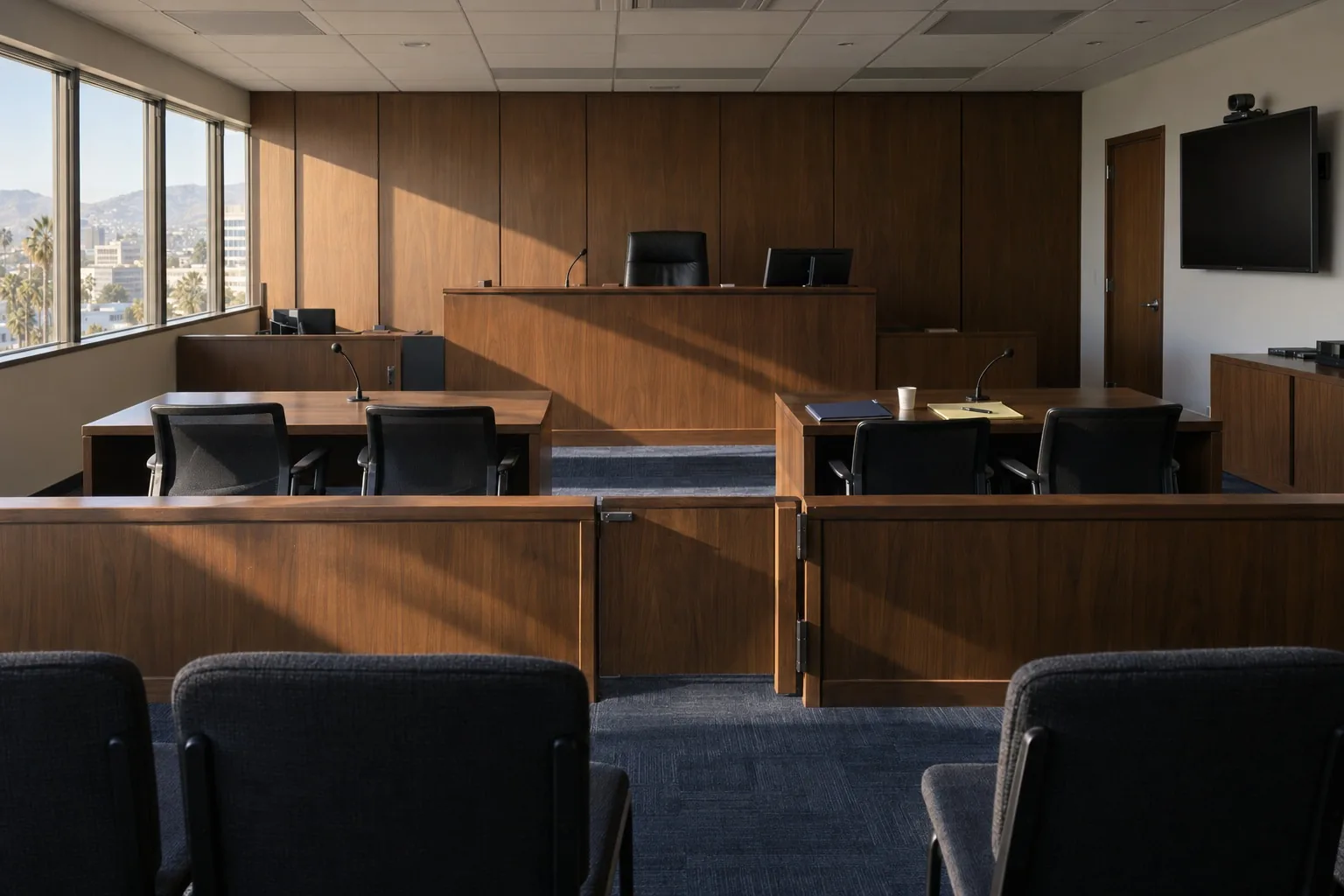







Removal (deportation) defense is representation before an immigration judge after the government starts a case to deport someone. Nassiripour Law Firm, in Irvine, represents people in removal proceedings from the first master calendar hearing through bond, the individual hearing, and appeals to the Board of Immigration Appeals and the federal courts. Clients have direct access to the attorney handling their case, Ali R. Nassiripour.
What are removal proceedings?
Removal proceedings are the immigration-court case the Department of Homeland Security (DHS) brings to deport someone. The case begins when DHS files a Notice to Appear (Form I-862) with the immigration court. An immigration judge decides whether the person is removable as charged and whether they qualify for relief that allows them to stay (INA § 240).
Immigration courts are federal. The judges belong to the Executive Office for Immigration Review (EOIR), part of the U.S. Department of Justice, and they apply federal immigration law. Orange County cases are generally heard at the Santa Ana Immigration Court; cases of people held in detention are heard by the court that covers the detention facility.
I received a Notice to Appear. What should I do first?
- Read the charges. The notice lists the facts DHS alleges and the legal grounds for removal. Mistakes in either matter.
- Confirm the hearing date. Check EOIR’s Automated Case Information portal or call 1-800-898-7180, and check again before every hearing, because dates move.
- Keep your address current with the court. File Form EOIR-33 within five days of moving. Hearing notices go to the last address on file (8 C.F.R. § 1003.15(d)(2)).
- Keep every notice and envelope you receive from the court or DHS.
- Speak with an immigration attorney before the first hearing. Some forms of relief have deadlines that run from your arrival date, and some choices made early are hard to undo.
What happens at a master calendar hearing?
A master calendar hearing is a short, preliminary hearing, usually with many cases on the same docket. The judge confirms your identity and address, asks whether you have a lawyer, takes pleadings (admitting or denying the factual allegations and the charge), and asks what relief you intend to seek. The judge then sets deadlines for applications and evidence and schedules the next hearing. Many cases have more than one master calendar hearing.
What is an individual (merits) hearing?
The individual hearing is the trial of the case. You and your witnesses testify, the DHS attorney cross-examines, the judge considers the documents and expert evidence filed, and the judge decides the application for relief, often at the end of the hearing. Preparation, including declarations, country-conditions evidence and witness preparation, usually starts months before.
What defenses and relief are available in immigration court?
The options depend on the person’s history, family and manner of entry. Common ones include:
- Asylum, withholding of removal and protection under the Convention Against Torture, for people who fear persecution or torture in their home country. Asylum generally must be filed within one year of arrival unless an exception applies (INA § 208(a)(2)(B)).
- Cancellation of removal. For a person who is not a permanent resident, it generally requires ten years of continuous physical presence, good moral character, and exceptional and extremely unusual hardship to a U.S. citizen or permanent-resident spouse, parent or child (INA § 240A(b)). A separate form exists for permanent residents (INA § 240A(a)).
- Adjustment of status before the judge, where a family or other petition makes a green card available.
- Contesting the charges, motions to terminate, and requests for prosecutorial discretion by DHS.
- Voluntary departure, which in some cases lets a person leave without a removal order (INA § 240B).
None of these is automatic. Each has its own eligibility rules and must be proven with evidence.
Do I have a right to a free lawyer in immigration court?
No. A person in removal proceedings has the right to be represented by a lawyer, but at no expense to the government (INA § 240(b)(4)(A)). There is no public defender in immigration court. The court provides a list of free legal service providers, whose capacity is often limited.
What happens if I miss my immigration court hearing?
The judge can order you removed in absentia, meaning in your absence. That order can be challenged with a motion to reopen: within 180 days if the absence was caused by exceptional circumstances, or at any time if you did not receive proper notice of the hearing (INA § 240(b)(5)(C)). Speak with an attorney as soon as you learn of a missed hearing.
What if the immigration judge rules against me?
The decision can be appealed to the Board of Immigration Appeals (BIA). The notice of appeal must be received by the BIA within 30 days of the judge’s decision (8 C.F.R. § 1003.38(b)). A BIA decision can then be reviewed by the federal court of appeals; for California that is the Ninth Circuit. Motions to reopen and to reconsider are separate options, generally due within 90 and 30 days (INA § 240(c)(6)–(7)). See Appeals and motions.
Can a New York–licensed attorney represent me in a California immigration court?
Yes. Immigration law is federal. An attorney who is a member in good standing of the bar of any U.S. state may represent clients before the immigration courts and the BIA (8 C.F.R. §§ 1001.1(f), 1292.1(a)(1)). Ali R. Nassiripour is licensed in New York and admitted to the U.S. District Courts for the Southern and Eastern Districts of New York. His practice is limited to federal immigration law, and he does not advise on California state-law matters.
How does Nassiripour Law Firm handle a removal case?
Clients work directly with Ali R. Nassiripour. A removal case at the firm typically involves:
- reviewing the Notice to Appear, the immigration history and any criminal record for errors and options;
- requesting bond or release when the client is detained (see what to do when a family member is detained);
- preparing the applications, declarations and evidence for each form of relief;
- representing the client at master calendar and individual hearings; and
- appeals to the BIA, motions, and federal-court review where the case calls for it.
Related: Detained cases · Asylum and removal proceedings · Ali R. Nassiripour
How to reach Nassiripour Law Firm
Nassiripour Law Firm, 15615 Alton Parkway, Suite 450, Irvine, CA 92618. Phone (718) 916-4407, or use the contact form. Ali R. Nassiripour speaks English, Farsi and French. Staff also assist clients in Spanish, Hindi, Punjabi, Mandarin and Arabic.
Attorney advertising. This page is general information about U.S. immigration law, not legal advice, and the law in this area changes often. Reading it, or contacting the firm, does not create an attorney-client relationship. Every case depends on its own facts, and no outcome can be promised. Ali R. Nassiripour is licensed in New York; his practice is limited to federal immigration law.